Thursday, September 10, 2009

Sweetest place in India-- Kanthaloor

Kanthaloor -- a village in Idukki district.

It is 7,000 feet above sea level.


Like any other village, it is green and lush.

A two hour bus journey will take you to Kanthaloor.
I call it the sweetest place in the country-- They make the best Jaggery here.

Jaggery is made out of sugar cane.

Which grows in abundance in Kanthaloor.
Kanthaloor also has a beautiful climate.


Sugar cane juice made first.


And it is boiled.


The residue is used as fuel in to boil the juice.


It is poured into this giant tava.

Where it is boiled for hours.

And hours...


And Hours...
More fuel is added to the boiler at times...


The Chimmeny lets out black smoke...

And more smoke...


The molten sugar cane juice coagulates after a while..


It is then poured into another container..


And poured..

And poured...

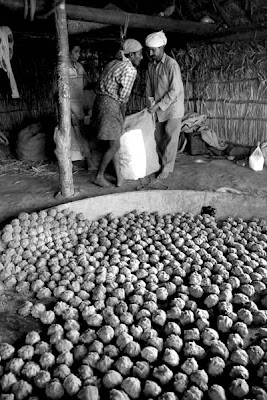
When it becomes a solid, the people make jaggery balls out of them...


More balls...


It is then weighed and packed in bags..

And weighed...


And packed...
Balls...

Friday, July 24, 2009

Nilambur

July is not the right time to go to Nilambur forests. The rain is usually at its peak. Leeches and Elephants are not exactly in the best of their moods. The nature is shaky. Landslides are common. These are the factors that me into the forests. The rainy season, is like a festival-- I decided to celebrate in the dense forests of Nilambur. July it had to be.

Another purpose of the journey was to meet the CHOLANAICKERS a primitive tribe living in the Nilambur forests.

The Beginning..

We met some people on the way. Who offered to guide us through the forest.


Chollan, our guide likes to walk barefoot in the forests. It is as if he did not care about the leaches ..


The climb to Kannan's house (a Cholanaikan) is risky. One wrong step could leave you injured and unable to continue the journey.


A 50 meter (approx) bridge to cross the river takes en rout to Kannan's house.


Enikkal Chollan, another tribesman who tagged along.


The bridge is made of bamboo and tree fiber.


Chollan.


Chollan.

Kannan's house turned out to be a sheltered cave.

Kannan's family. He has four children. Two of them have not been named yet. Kannan's wife has been here three years without going down the hill.

The whole family lives in the small area shown in the frame.


Billy and Mr No Name (left)-- Kannan's children.

Prakash-- Kannan's eldest son.

Billy and two children who are yet to be named.

The man of the house with the family.

Off to work.


Kannan'n brother's family (next cave neighbor)


On the way back. The government has made houses for the tribesmen. Most of them do not live here as it is difficult for them to go into the forest every day to collect honey and other products. Most of them live in caves like Kannan.


Saturday, April 25, 2009

Shravanbalgola

Shravanbelagola, located 51 km south-east of Hassan in Karnataka is one of the most important Jain pilgrim centres of India.


The Statue of the Jain saint Gommateshwara (AD 981) carved out of a mountain, said to be one of the tallest and most graceful statues in the world, is situated in this small town atop the Indragiri hills. The colossal monolithic statue is 58 ft high, naked, with 26 ft wide shoulders, 10-ft of its feet. Starkingly simple, the beautifully chiseled features of this statue embody serenity.


Nearly 1,800 years old, the statue which is reached by climbing 700 steps carved in the steep granite slope, is symbolic of the renunciation of worldly possessions. It was sculpted by Aristanemi in 981 AD and Chamundaraya, a general and minister of the Ganga King Rachamatta installed it in 983 AD.


In addition to the statue, there are several Jain bastis (temples) and monasteries in Shravanabelagola. There are 14 shrines on Chandragiri hill and Chandragupta Maurya the Great Emperor is buried here. Of the temples the Chamundaraya basti, build in 982 is the most remarkable. There is a spacious sanctuary in Bhandari Basti about 200 meters to the left from the path leading to the Gommateshvara Statue containing the 24 images of Tirthankaras.


Lord Gomatesheshwara was the Jain prince Bahubali. During a war with his greedy elder brother, Bharata who sought to usurp his kingdom, Bahubali accepted defeat at the moment of his victory when he realized the futility of it all. He renounced the world and his rights to his own kingdom, much to the severe repentance of Bharata and left to lead a life of penance and meditation, attaining Nirvana.


This lady is being carried to the hill top by locals who charge about Rs 250.

He's not getting paid for it.


Thousands of devotees congregate here to perform the 'Mahamastakabhisheka' (sacred anointment), a spectacular ceremony which is the focus for Jain pilgrims across India, held once in 12 years. Hundreds of pots containing curds, milk, honey, vermilion, coconut water, turmeric paste and even gold and precious jewels are poured over the statue's head by priests. The next Mahamastakabhisheka will be held in 2006 AD.


Early morning climb is the best for two reasons-- For a superb view and to escape the heat.


Shravanabelagola attained historical importance when Chandragupta Maurya, the greatest King of Mauryan Empire, settled on this hill in 3rd century BC, along with his Guru Bhagwan Bhadra Bahu Swami, after renouncing his kingdom. Bhadra Bahu was the greatest propagator of Jain faith in the South.

Thursday, March 19, 2009

Tibetan Village in Bailakkuppe

A strong longing for the mother land, a deliberate attempt not to loose their identity in a host-nation for over half a century, the simmering protests with in and the overwhelming peace and the unbelievable calm over the cruel turbulent history of suppression marks the Tibetan life in exile.

As the Olympic Torch was flown across continents wrapped up in heavy security, I was reminded of the lamps of peace and meditative calm of "Lugsum Samdupling", a Tibetan settlement and Monastery in Bailakkuppa near Mysore, Karnataka. The place was so full of light and wisdom and people moved around as if they don’t even feel the weight their own body. The little lamas in deep pink gowns scurried all over the place giggling. They seemed to have no complaints. Or is it their way of continuous protest, a strong silent one? A smiling dissent? A nuanced one perhaps!

Monks blowing a trumpet which gives out a deep sound. It helps them meditate- some said.


A monk kid carrying food. He offered me food- Thought I couldnt accept the food, I thought it would make a good frame.


Tea break in Bylakuppe monastry. Its a fun event every day.


It started raining...and the monks rushed to find shelter. The cool breeze and smell of fresh mud was soothing.
Chit- Chat during a prayer session.

A very old monk...


Looks like coke, fanta, mirinda and pepsi have made their way into the monastry. A couple of monks checking out an assortment of soft drinks on display inside one of the monastries.


You will have to go to the Forbidden City or trek Himalayan country under siege to know exactly how the ‘ideological pressures’ are having thier toll on the tradition of anachronisms and mysticism. But still, a visit to the monastery and the adjacent Tibetan settlements in Bailakkuppe would show you how the Tibetan people try hard to keep up the pace with the changes outside and inside. Will they ever be able to go back to their home land and live a life of ‘mysticism and jollity’?

Tuesday, February 24, 2009

one day assignment


Assignment 1: A child had died early in the morning after receiving improper treatment at a hospital.


Off beat...

A woman struggling with her child's carriage. She had come to see the flower show at Lal Bagh.

At Lal Bagh flower show.

Assignment 2: Photographs for a story saying that the footfalls in malls have come down and they are offering huge rebates.


In front of a second hand book stall at Avenue Road (one of the busies commercial streets in Bangalore).
A boy selling public service commission application forms near Kaveri Bhavan.
A bike parked right in front of a No Parking board.

Woman at a market.

A street vendor at K R Market..still smiling (evening).

Monday, February 2, 2009

Danuskodi


Kaliamma runs a tea shop in Dhanushkodi, She has been around for a while (since 1981). She has seen the changes take place in her town. Dhanushkodi is an old town which was devastated in the 1962 cyclone. It is a fishing town and is the nearest land peice to Srilanka. Many men from this town have migrated to Srilanka which is barely 20 kilometers by sea.


Tamil speaking people often migrate to this town for fear of their lives as the war between the LTTE and Srilankan government rages.


Fishing is the mainstay of their economy. One needs to travel on the van (shown above) to get to Dhanushkodi (a land piece in the middle of sea).


Kokila a first standard student. Her parents are fisherfolk.


This place is well lit for a good photo shoot. Vibrant with colors and the vast expanse of the sea gives you an overwhelming experience.


Though many tourists visit Dhanushkodi, the sea washes away all dirt. The town is still clean and plesant.


Fishermen return home after a days catch.


The reds, yellows and blues against the backdrop of a clear sky are apt for a perfect composition.


Shadows, due to the ample light are prominent in the place.


The wall of a church which was partially destroyed during the 1962 cyclone.


Pamban bridge, which connects Rameswaram to the mainland in Tamilnadu is considered to be one of the longest and strongest bridges down south.

Monday, December 1, 2008

Hampi

Rain at Hampi brings on a melancholic mood. As the lens sweeps the stretches of boulder- strewn hills on a particularly rainy and cold day, Hampi reminds one of the famous Greek philosopher’s favorite quote- `nothing endures but change…’.

This rock has stood testimony to the rise and fall of a dynasty.


A woman selling banana's to the visitors...


These boulders made me feel small...looking at them through my lens, gave me confidence- yes, it will fit the frame.


I was captivated by the off beat visual potential the place had to offer. My decision to avoid the often photographed and written about Hampi was right. There is another Hampi to be seen...


If you are headed to Hampi with the been-there-seen-that-done-this attitude, you will miss the real sights. Some sights are apparent only to the relaxed mind...
Auto's are everywhere...


Here too..
A pilgrim in Hampi Bazar...
Crouched in her tea shop, a woman bears the cold, waiting for a customer.

The Tungabadra river supports many activities of the localite. Washing clothes being one of them.

A hidden path to Vittala temple from Virupasha temple


Time has weathered the rocks.

A ruined temple


A man makes his way to the ruins. He has a bucket of water with him, to wash his behind after he is done with defecating in the bushes near the ruins. Truly a kings retreat.


5.45 am at the shores of Tungabadra- Hampi is waking up.


I headed back to the city...
Getting There (Text from http://india.journeymart.com/hampi/default.asp) : The nearest railway station is at Hospet. There are trains to Hospet from Bangalore and Hyderabad. You can get to Hampi from Hospet by auto-rickshaw, bus or rented cycle. It is possible to rent a chauffeur driven car in Hospet. It is convenient to get directly to Hampi by road. Goa is 10 hrs away and there are bus services from all over Karnataka to Hampi. Since this is a major tourist destination, any number of car-rentals will be happy to provide you with a car and driver for the trip. You can hire the car and take it around the entire northern circuit of Hampi-Hospet-Badami-Gulbarga-Bidar-Bijapur. It is also possible to hire a car at Hampi.

There are frequent bus services to Hospet (30 minutes) and from there on to Badami, Bijapur, Aihole, Gulbarga, and to the south too. You can also rent a car for the trip. There are trains from Hospet to Bangalore, Secunderabad (Andhra Pradesh), and Belur-Halebid. There is also a train to Badami.

Getting Around: The best time to visit is October. The weather is cool and a gentle breeze sweeps the countryside. The ruins of Hampi are fairly spread out so it is wise to rent a cycle for getting around locally. However, be prepared to do some bits on foot because in places the dirt track is not negotiable even on cycle. Auto-rickshaws and taxis are also available but not really conducive to a detailed exploration. Take along sturdy footwear if you are planning to do the ruins on foot.